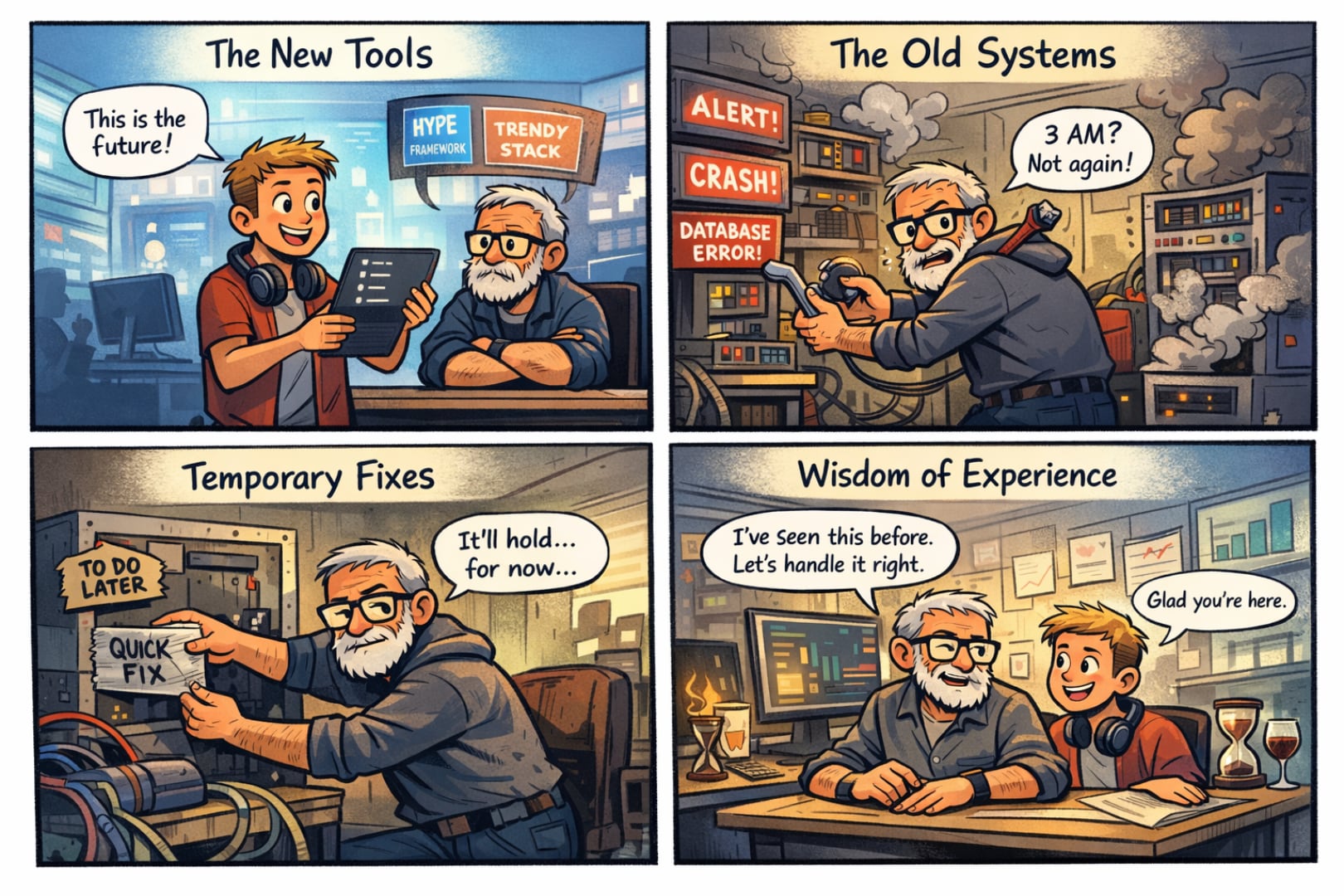
Do skills really become outdated, or do tools just get replaced?
In tech, experience is often treated like something with an expiration date. New tools appear, trends shift, and suddenly years of hands-on work are quietly assumed to be less relevant.
But software does not age that way.
Systems age. Data ages. Business logic ages. Legacy constraints pile up. Technical debt accumulates. The real world is rarely built from scratch, and most engineering work happens in the messy middle - maintaining, extending, and migrating systems that have a history.
Yet the conversation around relevance tends to focus on frameworks and syntax, as if the hard-won lessons from those systems only apply to greenfield projects.
Tools change fast. Principles do not.
Real-world systems still depend on the same core challenges: managing state, ensuring data consistency, handling concurrency, designing for failure, optimizing performance under constraints, building for observability, implementing proper error handling, background processing, scalability, and long-term maintainability. These problems do not disappear when the syntax changes. They only get repackaged.
Engineers who have worked on long-lived systems understand how shortcuts compound, how "temporary" solutions linger, and how real software behaves under pressure. That perspective becomes more valuable, not less, as systems grow and evolve.
The industry's real shift is not from one stack to another. It is from knowing tools to understanding systems, and from building features to owning outcomes.
Seen this way, experience does not expire.
It matures.
And mature experience, like good wine, tends to matter most when the stakes are high.